
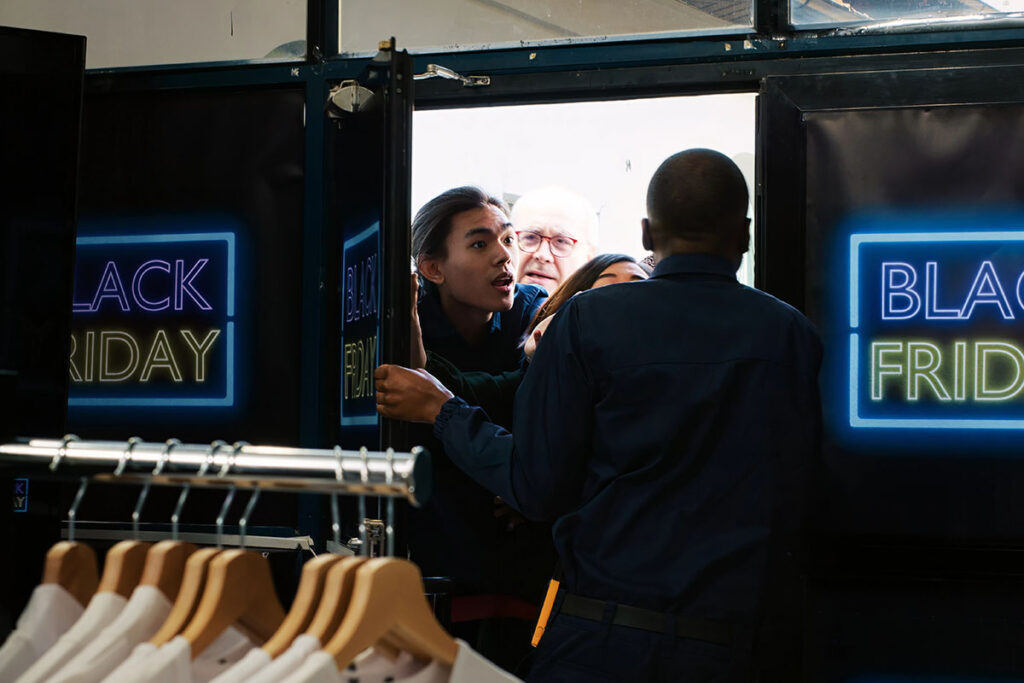
For many Americans, Thanksgiving weekend comes with two traditions: gathering around the dinner table and hunting for Black Friday bargains. Shopping lists are made, deals are bookmarked, and plans are arranged well before the holiday arrives. Not so long ago, eager shoppers headed to stores on Thanksgiving evening or spent hours waiting in line for doors to open at dawn, hoping to be first in line for the biggest discounts.

Today, the shopping experience looks a little different. Doorbuster deals have expanded into weeks of promotions, and shoppers can browse discounted televisions, electronics, and holiday gifts without ever leaving their couches. The overnight lines may not be what they once were, but the demand for bargains hasn’t disappeared.
For retail employees, however, Black Friday is about much more than finding a good deal. It’s a season of early shifts, merchandise deliveries, crowded stores, online orders, and customers eager to get their hands on the year’s most popular products.
And while shoppers may spend weeks anticipating the savings, the people working behind the scenes are preparing for an entirely different kind of holiday rush.
From One Day to Nearly a Month of Deals
Black Friday falls on November 27 this year, but the shopping event has already begun.
Walmart launched its first 2026 Black Friday promotion November 12–15. Its second event runs November 23–29, followed by Cyber Monday deals November 30–December 2.
That’s 14 promotional days spread across a 21-day period, compared with 10 sale days in 2025.
For shoppers, the longer calendar offers more opportunities to save. For employees, it creates additional work beyond the traditional Thanksgiving weekend.
Twenty years ago, much of the preparation centered on a single store-opening rush. Employees stocked displays, organized merchandise, rehearsed crowd-control procedures, and prepared for customers who might empty shelves within minutes.
A former Toys “R” Us employee, recalling the Tickle Me Elmo craze of the 1990s in a published account, described adults fighting and shoving to reach the popular toy. The store ran out of large shopping bags before the morning was over, leaving cashiers to deal with frustrated customers.
These kinds of incidents helped define Black Friday’s reputation for chaos.
But the modern shopping season presents a different challenge. Retail employees may now handle several waves of promotions rather than one overwhelming morning.
The National Retail Federation expects retailers to hire between 325,000 and 375,000 seasonal workers in 2026. Those workers join existing employees across sales floors, stockrooms, distribution centers, and online fulfillment operations.
What Happens When a Popular Deal Hits the Floor?
This year’s Black Friday promotions include some substantial discounts on electronics and household products.
At Best Buy, a 65-inch Samsung OLED television has been advertised for $899.99, compared with a listed price of $2,099.99. A 48-inch LG OLED television has appeared for $599.99, compared with $1,199.99.
Walmart’s early promotions include a Ninja air fryer for less than $100 and a Shark FlexStyle hair-styling tool for less than $200.
But what happens behind the scenes when customers want those products?
Someone must receive merchandise, organize it, locate available inventory, prepare displays, and help shoppers navigate limited quantities. Large electronics may require employees to retrieve and move bulky boxes, while smaller products can generate questions about availability, substitutions, and sale restrictions.
The work becomes particularly demanding when in-store traffic overlaps with online orders.
A clothing store manager described exactly that combination in a public account of Black Friday weekend in 2025.
At her Garage Clothing location, the doors opened at 7 a.m. Within minutes, the store was so crowded that an employee had to monitor the number of customers entering.
Then the workload changed again.
The manager reported that the store’s buy-online, pick-up-in-store order volume doubled unexpectedly. More than 100 boxes of merchandise arrived over the busy weekend, and a Saturday snowstorm complicated operation.
Employees still had to manage customers, process inventory, and prepare pickup orders. The manager credited her team with exceeding its performance targets despite the disruptions.
It’s a more revealing picture of modern Black Friday than the usual image of a crowded checkout line. An employee might be helping customers find clothing for one moment and processing online orders or unpacking inventory the next.
And the online workload is hardly new. As far back as 2019, a Zara employee in Manhattan described spending part of her day assisting shoppers before moving to the stockroom to pack roughly 50 online orders. Her store was anticipating approximately 2,000 orders to ship during Black Friday weekend.
For employees, the growth of online shopping hasn’t necessarily eliminated work. It has changed where that work happens.
The Holiday Schedule Nobody Sees
One of the biggest challenges for retail employees isn’t necessarily the customers. It’s the schedule.
In a published account from 2015, a Kohl’s employee described working through an exhausting Thanksgiving stretch.
Her shift before Thanksgiving ended at 12:30 a.m. With her commute, she expected to arrive home around 1 a.m.
She was also hosting a Thanksgiving dinner for 15 family members.
After preparing the meal and spending part of the holiday with her guests, she planned to leave around 5 p.m. to begin another shift at 5:30.
That shift would continue until shortly after midnight. She was then scheduled to return to work at 6 a.m. on Black Friday for another eight-and-a-half hours.
The difficulty wasn’t simply working on a holiday. It was trying to fit sleep, family responsibilities, and multiple shifts into a schedule with very little time between them.
Not every retailer operates that way today.
Walmart, for example, is closing its U.S. stores on Thanksgiving Day in 2026, with its main Black Friday in-store event beginning at 6 a.m. on November 27.
That represents a meaningful change from the years when some major retailers opened on Thanksgiving evening.
Still, employees may be needed before opening to prepare merchandise and after closing to recover the sales floor. A store’s posted shopping hours don’t necessarily reflect the full working day for everyone on staff.
Extra Pay, Employee Discounts, and Other Benefits
Working during the holidays can offer advantages, particularly for employees looking to earn extra income.
But the benefits vary considerably by employer.
Target’s advertised 2026 seasonal starting wages range from $15 to $24 an hour, depending on the position and location. The retailer also promotes additional pay for certain early-morning and overnight shifts.
Seasonal employees have access to benefits that include a 10% employee discount, additional discounts on select wellness products and adult owned-brand clothing, early access to earned wages, backup childcare services, and virtual healthcare support.
Kohl’s advertises weekly pay, flexible schedules, and a 15% employee discount for seasonal associates. Its seasonal roles also offer the possibility of transitioning into longer-term employment.
Those benefits can be meaningful for employees purchasing holiday gifts for their own families or seeking temporary income.
However, working Black Friday does not automatically guarantee double pay or time-and-a-half.
Under federal law, covered nonexempt employees generally qualify for overtime pay after working more than 40 hours in a workweek. Black Friday is not a federal holiday requiring premium pay. Any additional holiday compensation depends on applicable laws and employer policies.
Beyond formal compensation, stores sometimes provide meals, employee celebrations, or other gestures during the holiday rush.
These smaller benefits may not appear on a paycheck, but they can influence how employees feel about returning for another busy season.
Why Some Workers Actually Enjoy It
Not every retail employee dreads Black Friday.
Some enjoy the excitement, teamwork, and satisfaction of getting through an unusually demanding shift.
During the 2023 holiday shopping season, employees at California’s Valencia Town Center described a more positive experience than the chaotic Black Fridays of previous years.
Workers credited supportive coworkers and adequate staffing with helping them manage busy stores. One employee remembered the pleasure of seeing children singing as they passed through the mall, while others recalled holiday carolers and customers who were generally in good spirits.
For some employees, the rush brings people together. Coworkers help each other locate merchandise, answer questions, cover registers, and manage unexpected problems.
The shared experience can make a difficult shift surprisingly rewarding.
For others, however, the pressure becomes exhausting.
In 2024, a senior bookseller at an independent New York bookstore described the strain of spending hours helping customers select gifts while navigating their holiday stress.
It’s a different experience from managing a crowded electronics department, but it illustrates another side of seasonal retail work: helping one customer after another make decisions while maintaining patience and providing personal attention.
Small businesses face their own holiday demands, especially during Small Business Saturday, which falls on November 28 in 2026.
For employees at independent bookstores, boutiques, gift shops, and specialty retailers, the holiday weekend can mean extended customer service, wrapping gifts, managing inventory, and helping shoppers find something meaningful.
The setting may be smaller than a Walmart or Best Buy, but the human demands of holiday retail remain.
The People Behind the Purchases
Black Friday has changed dramatically over the past two decades.
The shoppers who once waited outside stores in the darkness now have the option to order from their phones, arrange curbside pickup, or browse promotions weeks before Thanksgiving.
Some of the most frantic store-opening scenes have become less common. At the same time, online fulfillment, multiple promotional events, and changing customer expectations have created new responsibilities for employees.
A shopper might spend five minutes purchasing a discounted television. Before that purchase happens, workers may have spent hours receiving shipments, locating inventory, arranging merchandise, preparing orders, and answering questions.
And after the customer leaves, the work continues.
Some employees will remember the exhaustion. Others will remember coworkers who helped them through a difficult shift, a grateful customer, or an unexpectedly enjoyable holiday atmosphere.
Their experiences aren’t all the same, and that’s part of the story.
For shoppers, Black Friday may be about finding the right deal. For the people working behind the registers, stockroom doors, pickup counters, and loading docks, it’s an entire season of work that most customers never see.

We don’t just report the news, we deliver it through the voices of multiple expert staff writers, each selected to broaden our scope and deepen our storytelling.
