
An exclusive follow-up to Netflix’s Trust Me, False Prophet.
There are stories that make headlines.

And then there are stories that begin after the cameras leave.
Soon our team will travel to Short Creek, Arizona—the very same community where the Fundamentalist Church of Jesus Christ of Latter-Day Saints (FLDS) took root under Warren Jeffs and where, years later, another self-proclaimed prophet, Samuel Bateman, was accused of continuing a devastating pattern of abuse and control. For many viewers, Netflix’s Trust Me, False Prophet revealed the shocking reality that these events were not simply part of a distant past but continued into recent years.
Our story begins where one leaves off.
We aren’t returning to revisit the headlines. We’re there because the women are still living beyond them.
Shandra and Marona Johnson—two of five biological sisters who became plural wives of Samuel Bateman—have invited us into the next chapter of their lives. As they continue reclaiming their voices, their choices, and their future, our team has been given the extraordinary privilege of walking alongside them.
We’ve gathered an intentionally diverse group of physicians, educators, coaches, humanitarian leaders, and storytellers. Even that is unusual. We aren’t arriving as individuals pursuing separate interviews, but as a collaborative team committed to earning trust before asking for someone’s story.
Where that journey ultimately leads are still unfolding. And that’s exactly the point.
For years, the public narrative centered on Warren Jeffs and, more recently, Samuel Bateman. The headlines documented systems of power that dictated nearly every aspect of many women’s lives—their marriages, their families, their appearance, their faith, and often, their choices.
Far less attention has been given to the women who lived those stories. Until now.
False Prophet brought national attention to the abuse many of us were surprised to learn was still unfolding within the last few years. When Samuel Bateman was arrested, mothers were separated from their children. Acting on instinct, they went to get them—and found themselves incarcerated as a result. We are here to tell you this story.
What does obedience mean when you’re simply trying to do what you believe is right?
We recently had our first production call with Shandra & Marona. I wondered if it would be difficult for them to share vulnerably. After brief introductions, I heard hope and belief that we were a ‘safe space’ for their truth. They had trust.
Shandra and Marona spoke with untamed courage: “If my story helps one other woman, then it will have been worth it.
Shandra also shared that her sister encouraged her to use her voice. You could feel the quiet strength they drew from one another and the love that continues to unite them as they stand beside their mother, Julia, who was featured in the Netflix Series as one of the main FBI informants.
Together, they told us they’d written ten chapters of their book, realizing they’d barely begun to explore what was happening inside. They had documented the events but not yet given voice to the emotions.
Isn’t that true for so many of us?
We become skilled at explaining what happened yet struggle to express what it felt like.
As someone who works in voiceover and transformational vocal empowerment, I often say our voice doesn’t just come from our throat. It begins in our heart—with permission to feel, to question, and to discover what is true for ourselves. Once we find that emotional truth, we can finally speak it.
That doesn’t belong only to women leaving a closed religious’ community. It belongs to all of us.
The word obedience has always unsettled me. As I listened to stories from the FLDS community, I kept hearing the women claim they were to obey and keep sweet. That left me wondering: At what point does obedience stop protecting us and start silencing us?
My mother challenged expectations placed on women. An environmentalist and marathon runner, she pushed boundaries—even threw her bra out of a moving station wagon in the 1970s. She believed women deserved the freedom to choose.
Listening to Shandra and Marona describe lives built around obedience challenged many of my own assumptions.
Oppression is Global.
We’ve met young women in Kenya who believed they had no choice but to exchange sex for money to buy menstrual products because they knew no other path. Through our humanitarian work distributing menstrual cups, we’ve met girls who simply accepted circumstances because they didn’t know another way existed.
Different continents. Different cultures. And yet there is a common thread.
What happens when women are taught obedience before they’re taught ownership of their own voices.
And yet obedience can also embody mindfulness, integrity, and intention—to honor the boundaries that keep us safe while remaining aligned with our own values.
Maybe this is part of the question that intrigues many on our team to take part in this story.
Choosing divorce after twenty-seven years of marriage, I found myself becoming the primary decision-maker in my own life. While my circumstances were very different from Shandra and Marona’s, I recognized something familiar about standing at the edge of freedom. It is beautiful and also terrifying. The question isn’t only “What do I choose?” but “Can I trust myself enough to choose?”
We won’t simply document what it means to leave one way of life. We will be asking: Who do I become when I choose another?
Choice sounds romantic until you’re the one responsible for making it. Freedom comes wrapped in uncertainty. Perhaps that’s why courage isn’t the absence of fear. It’s deciding to risk it anyway.
On zoom we each asked a question- mine felt a little superficial:
Their hair.
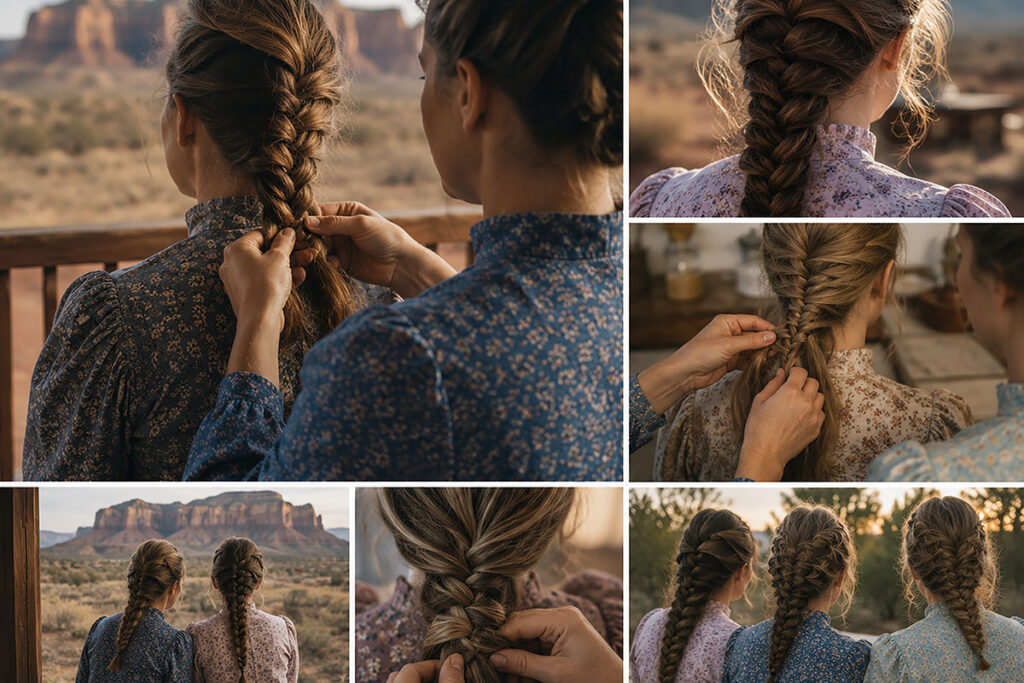
The intricate braids I’d seen in the documentary fascinated me, and I discovered that hairstyles within the FLDS community were prescribed. Do the braids symbolize conformity?
“I’m curious about your hair.” I asked, “Did you feel repressed wearing it this way, or did braiding become something that bonded the women?”
Shandra lit up! “I love braiding,” she said. “And I’m really good at it.” The pride of Shandra exhibited. I laughed. There went another assumption.
Across cultures, braids symbolize strength, unity, ancestry, resilience, protection, and the weaving together of individual strands into something stronger than any one strand alone.
Maybe that’s the perfect metaphor for this journey that began when author and publisher Zehra Mahoon introduced Executive Producer Sir David T. Fagan to sisters Shandra and Marona Johnson.
It was clear this would not be a typical filmmaker-subject relationship.
What would it look like to earn the privilege of someone’s story before asking them to revisit the most vulnerable chapters of their life?
Sir David T. Fagan has assembled an intentionally multidisciplinary team with one guiding principle: earn trust before asking for someone’s story. That philosophy shapes every conversation long before cameras roll.
To walk alongside Shandra and Marona, Executive Producer Sir David T. Fagan intentionally assembled an unlikely team. Producers and creative collaborators Isabel Donadio, Angela Legh, Melanie Soloway, Dr. Kelley Gurley, Dr. Tina Koopersmith, Dr. DeAndrea Fleming, Dennis DiNoia, Kelly Etter, and I each arrive from different worlds. Collectively, our backgrounds span filmmaking, journalism, medicine, gynecology, psychology, law, education, parenting, counseling, humanitarian work, meditation, vocal empowerment, identity transformation, and storytelling.
No one person is expected to hold this story alone.
We’ll undoubtedly encounter uncomfortable moments, ask imperfect questions, get sand in every camera bag.
And yes—I admit that I wouldn’t mind leaving Arizona with a spectacular fishtail braid.
Mostly, though, I know we’ll leave with a deeper understanding and a renewed respect for the courage it takes to rewrite your life while the world is still reading a chapter you never co-signed on.
Our cameras will document more than interviews. They’ll capture trust being built.
Moments when someone realizes—for perhaps the first time—that they are allowed to change their mind, tell a different story, or discover a truth they didn’t know was waiting inside them. Creating enough safety for discovery.
If we’re successful, this documentary—scheduled to premiere in December 2026—will become more than the story of two courageous women. They may offer a different model for storytelling—one that values relationship over sensationalism, listening over assumption, consent over extraction, and our shared humanity above all else.
Every braid begins with separate strands.
Ethical storytelling begins with trust.
The Johnson sisters bring lives shaped by experiences most of us can scarcely imagine. We bring our own stories, skills, perspectives, and experiences. Somewhere in the weaving of those very different strands, we hope to discover something none of us could have found alone.
And perhaps the greatest privilege isn’t telling someone else’s story—it’s being invited to witness them reclaim it.
Justine Reiss is a multi-award-winning voiceover artist and global advocate leveraging storytelling, service, and social enterprise to advance equity and empower women and girls.

Wow!! Wow!! Wow!!! Yea!!!
Thank you for doing this!!
❣️Zehra Interviewed Marona and Shandra in my home in New Jersey at our Gathering we had planned way back in January, months before the Netflix Documentary has come out.
❣️Cathy Seitchik Diaz