

When people think about self-defense, they often picture punches, martial arts, or physical confrontation. According to Philip Toppino, founder of WOFT and Vice President of Training at WRAP Technologies, that thinking has it backwards. Real safety begins long before a fight ever starts.

For Toppino, the most valuable self-defense skill is not learning how to overpower an attacker but recognizing danger early enough to avoid one. “The goal isn’t winning a fight,” he says. “It’s avoiding one whenever you can.”
Self-Defense Begins Long Before a Fight
One theme runs consistently through Toppino’s philosophy: self-defense is less about learning techniques than learning judgment.
Rather than asking, how would you defend yourself if someone attacked? Toppino asks a different question: How could you recognize the danger before it reaches that point?
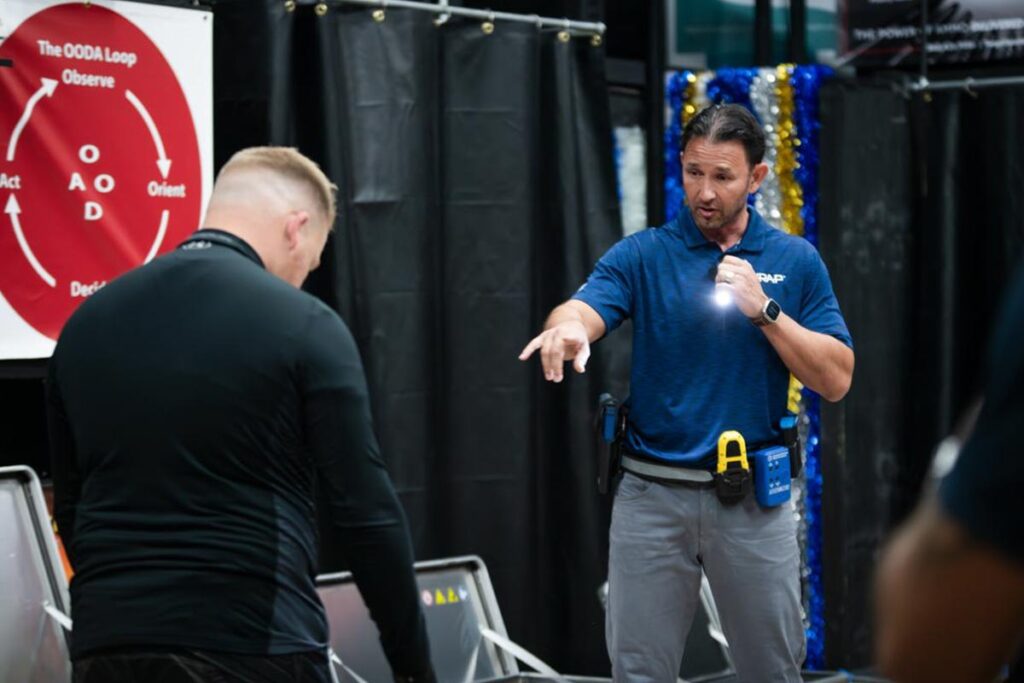
Instead of focusing solely on punches, kicks, or weapons, his training emphasizes situational awareness, communication, decision-making, and recognizing problems while options still exist. The objective is not to create fearless people looking for confrontation, but observant people who know when to leave, when to speak up, and when to avoid unnecessary risk altogether. “Most people will never have to fight,” Toppino explains. “And that’s exactly how we want it.”
Awareness Is Not the Same as Fear
One woman’s experience at an airport illustrates how quickly awareness can become an action. While she was at the luggage pickup area with her friend Kelly, they later went separate ways, with Kelly and another friend taking a different shuttle. The woman boarded a train with only five other passengers and soon became uneasy about a man there. The concern was not hers alone; a couple traveling with her also agreed that something about him felt “off.”
After reaching the platform, one of the couples went back to check whether the man had left. When he was no longer there, they contacted 911 and airport police, provided a description, and asked officers to locate and question him. The couple then walked the woman to her vehicle. She locked the doors immediately, drove to another parking lot, and recorded a video about the encounter, hoping police would find the man before he could put another woman at risk.
What makes the experience significant is precisely what didn’t happen: no physical confrontation was necessary. The woman noticed something that did not feel right, listened to that instinct, and took practical steps to create distance and bring other people into the situation. The couple did the same thing. Rather than dismissing the feeling or waiting for the situation to escalate, they acted while they still had options. That is the kind of awareness Toppino describes: not paranoia, but the ability to recognize uncertainty, decide, and move toward safety before danger becomes unavoidable.
The Best Success Stories Never Become Fights
Some of the strongest evidence for Toppino’s philosophy comes from those who have experienced his training firsthand.
Healthcare executive Dave Santana describes WOFT as a family experience that strengthened communication and left them feeling prepared rather than fearful. Outdoor personality Eva Shockey says the realistic scenarios taught her how to stay calm, recognize danger early, and respond with greater confidence. Commentator Lindsey Graham credits the hands-on coaching with transforming intimidating situations into practical lessons that gave her confidence to protect herself and her children. Lifestyle creator Britt Jill says the scenario-based exercises revealed how she naturally reacted under pressure, allowing her to build awareness and make better decisions before situations escalated.
Training the Mind Before the Body
Toppino’s approach also differs from many traditional self-defense programs because it focuses on how people naturally respond under pressure.
Instead of lining everyone up and teaching identical techniques, participants work through realistic scenarios designed around their individual abilities, family dynamics, and decision-making styles. Instructors observe how people instinctively react before helping them improve those responses through coaching and repetition.
The goal is not simply to memorize movements, but to develop judgment- a distinction that extends beyond the encounter itself. Toppino also emphasizes understanding what happens after a confrontation. Even when someone acts lawfully in self-defense, legal, financial, and emotional consequences may follow. Knowing when to use force, and when not to, is just as important as knowing how. As he explains, “Just because you can do something doesn’t always mean you should.”
Families Learn Together
Another recurring observation throughout Toppino’s work is that safety is rarely an individual’s responsibility. It is a family conversation.
After training, parents often report involving their children in discussions about awareness, while children begin noticing details they previously ignored. Families develop shared plans, communicate more openly, and gain confidence in their ability to respond together if something unexpected occurs.
Thinking Differently About Safety
Many students arrive expecting a conventional self-defense class focused on physical techniques. Instead, they discover that the most valuable lessons involve observation, communication, judgment, and preparation.
In the end, Toppino’s philosophy challenges one of the biggest misconceptions about personal safety. Fighting may be the most visible part of self-defense, but it is rarely the most important thing. The decisions made before a confrontation, the ability to notice warning signs, avoid unnecessary danger, and stay calm under pressure, often determine whether a confrontation happens at all. Real self-defense, it turns out, has very little to do with throwing the perfect punch. More often, it begins with seeing what others miss and making the decision that allows you and the people you love to return home safely.
To learn more about Philip Toppino and WOFT’s scenario-based family safety training, visit WOFT.com

We don’t just report the news, we deliver it through the voices of multiple expert staff writers, each selected to broaden our scope and deepen our storytelling.
